
Healthcare practices are often told that HIPAA compliance is inherently difficult—burdensome policies, expensive consultants, endless documentation, and constant administrative effort.
That narrative is convenient.
It is also incorrect.
Most compliance failures are not caused by ignorance, bad intent, or lack of effort.
They are caused by something more basic:
Practices are operating regulated environments without governance systems.
HIPAA does not fail practices.
Operating without systems that translate policy into enforced, auditable behavior does.
In regulated industries, this is not an oversight—it is an unmanaged risk posture.
The Real Problem: Compliance Without Governance
Most healthcare organizations have policies.
Many have training.
Some even have audits.
What they do not have is governance infrastructure—systems that make compliance the default state instead of a recurring project.
Policies express intent.
Governance systems produce outcomes.
Without governance, even well-run practices drift out of compliance—not because they are careless, but because nothing in their environment prevents it.
The Governance Maturity Model
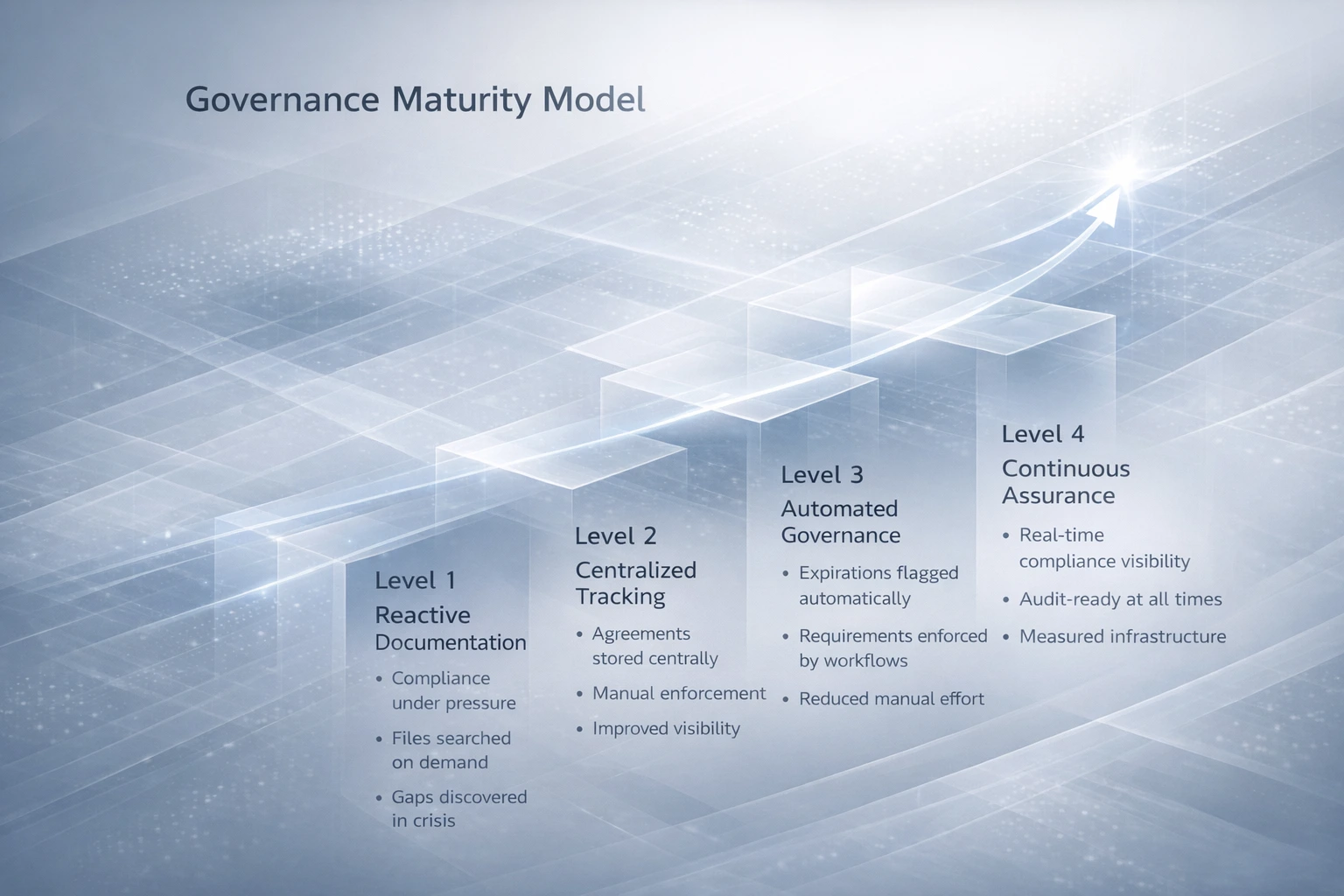
Governance is not binary.
It matures in predictable stages.
Organizations typically operate in one of four governance states:
Level 1: Reactive Documentation
Compliance assembled under pressure
Files searched when auditors arrive
Gaps discovered during crisis
Level 2: Centralized Tracking
Agreements stored in one location
Visibility exists
Enforcement depends on manual follow-up
Level 3: Automated Governance
Policy translated into system behavior
Expirations flagged automatically
Workflows enforce requirements
Level 4: Continuous Assurance
Compliance as measured infrastructure
Real-time visibility
Audit-ready at all times
Most practices operate at Level 1.
Regulated industries require Level 4.
Level 4 does not eliminate risk.
It makes risk visible, bounded, and defensible.
Where does your practice operate today?
The Hidden Cost of No Governance
This scenario plays out weekly across medical, dental, and therapy practices:
A practice manager receives notice of an upcoming audit
Someone asks for Business Associate Agreements
No one is sure where they all live
What follows is predictable:
Emails searched
Shared drives combed
File cabinets opened
Vendors contacted
Gaps discovered under pressure
Three staff members lose an entire day assembling documentation that is incomplete, inconsistent, and partially expired.
Cost: $2,400 in labor to answer a question the organization should answer instantly.
This is not a failure of diligence.
It is the predictable result of operating without governance systems.
The Hero Caught in the Middle
The practice manager becomes the de facto compliance officer—not by training, but by necessity.
They are responsible for:
Ensuring BAAs exist
Tracking expirations
Coordinating signatures
Producing documentation on demand
All without tools designed for the job.
They are asked to protect the organization from regulatory risk using:
Email inboxes
Spreadsheets
Shared folders
Institutional memory
This turns compliance into heroics.
Heroics are not a strategy.
The failure is not theirs. The system failed them.
What Governance Actually Looks Like
When governance systems exist, compliance becomes operational—not performative.
When an auditor asks for BAAs:
Practice manager opens a dashboard
Clicks “Generate Report”
Receives a complete, current PDF
Time: 30 seconds
When a new vendor requires a BAA:
Agreement uploaded
Routed for e-signature
Executed copy stored with audit trail
Time: 5 minutes
When an agreement approaches expiration:
System flags it in advance
Renewal initiated automatically
Time: 2 minutes
No urgency.
No scrambling.
No reliance on memory.
This is not idealized.
This is what governance infrastructure enables.
Why Peer Advice Fails Here
When practices ask peers how they manage compliance, the answers sound reassuring:
“We track it in a spreadsheet.”
“Our IT company handles that.”
“We keep everything in a binder.”
None of these answers are evidence.
Compliance failures are invisible until tested.
Most peer systems have never been tested.
Consensus is not validation.
Architecture is.
The right question is not:
“What is everyone else doing?”
It is:
“How fast can you prove compliance if tested today?”
The Cost of Operating Without Governance
Operating without governance systems creates predictable failure modes:
Audits
Emergency remediation
Consultant fees
Penalties for preventable findings
Median OCR penalty for small practices: $107,000
Breaches
Delayed response
Unclear scope
Extended investigations
Average cost per record: $408
Transactions
Reduced valuation due to undocumented compliance risk
Typical purchase price adjustment: $300,000–$500,000
These are not edge cases.
They are standard outcomes of unmanaged governance.
What This Means for Leadership
Healthcare executives face a question that transcends compliance:
Is our organization’s risk profile visible, measurable, and defensible—
or estimated, assumed, and hoped for?
Governance infrastructure determines the answer.
Boards and investors increasingly evaluate organizations not just on whether they have compliance programs, but on whether those programs produce auditable proof of continuous control.
Competitive Advantage Through Governance
Organizations with governance systems demonstrate advantage in:
M&A Transactions
Compliance infrastructure documented, transferable, and valued rather than discounted
Insurance Underwriting
Measurable controls reduce cyber liability premiums by 20–30%
Regulatory Response
Incident scope determinable in hours, not weeks
Operational Efficiency
Staff time directed toward mission, not documentation archaeology
This is not a technology question.
It is a governance maturity question.
Technology simply makes governance enforceable at scale.
What Changes When Governance Is Built In
When compliance is governed by systems:
Compliance stops being a project
It becomes a continuous state, visible at all times
Risk becomes measurable
Leadership knows where exposure exists—without guessing
Decisions accelerate
New technology evaluated quickly because compliance is built into workflow
The organization stops reacting.
It starts operating.
The System That Replaces Heroics
BeCloud’s BAA Manager provides governance infrastructure:
Centralized Agreement Repository
One source of truth. Always accessible
Automated Lifecycle Tracking
Expirations, reviews, and renewals surfaced automatically
E-Signature Workflows
No printing, scanning, or chasing
Complete Audit Trails
Every action logged, timestamped, and defensible
This is not advanced technology.
It is overdue governance.
The Only Question That Matters
If compliance can be governed instead of chased, why are you still chasing it?
If governance systems can enforce policy automatically, why rely on memory and spreadsheets?
The only acceptable answer is:
“I didn’t know there was another way.”
Now you do.
Your peers can tell you what they hope works.
BeCloud can show you what does.
When the auditor shows up, the difference matters.
BeCloud’s BAA Manager
Governance for HIPAA compliance—built into infrastructure.
Centralized tracking
Automated oversight
Audit-ready reporting
No consultants.
No spreadsheets.
No heroics.
Start Free Trial